Lesson 5: Lipids
5.3 Parenteral requirements
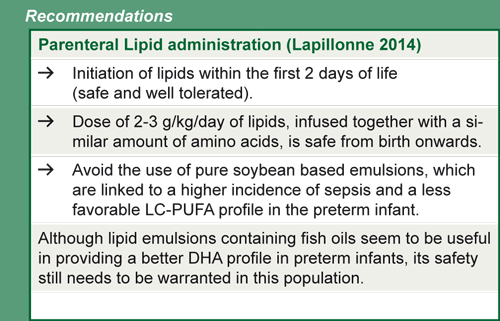
Parenteral lipid administration represents a non-carbohydrate source of energy in a low volume and low osmolarity. Due to the growing amount of evidence that lipids early on in the preterm infant life may determine various outcomes in later life - such as physical growth and intellectual development - parenteral lipid administration should be initiated soon after birth (Lapillonne 2014). Vlaardingerbroek and van Goudoever recommend initiation of lipids within hours of birth:
"Considering
the good tolerance and many theoretical advantages of early lipid
administration for protein synthesis and anabolism, amino acid tolerance, and
the prevention of EFA deficiency, we recommend initiation of lipids within
hours after birth."
(Vlaardingerbroek & van Goudoever 2015).
As already discussed in unit 1, lesson 2.7 Respiratory System, pure soybean-based lipid emulsions should be avoided in preterm infants when alternative emulsions based on a mix of oils are available, due to higher risk of pulmonary effects and sepsis. In preterm infants, newer lipid emulsions with MCT's, olive oil, and/or fish oils may offer many benefits (lower incidence of sepsis, maintenance of liver integrity and neurodevelopment) and should be the preferred choice in the NICU (Vlaardingerbroek & van Goudoever 2015).