Lesson 2: Why Do Some People Get Celiac Disease and Most Don't- Although They All Eat Gluten?
Optional further information: Genes in celiac disease
Genes contain the „construction plan“ for every molecule in our body. The genes that are associated with a risk for celiac disease are involved in the production of parts of our immune system. You can consider the immune system as „police“ of our body. It consists of millions of immune cells which act as „policemen“: their job is to distinguish foreign proteins originating from potentially harmful bacteria, viruses or poisons from harmless ones found in our body or for example in the food we eat.
Therefore special immune cells are always on patrol to identify potentially harmful organisms or structures (see figure 6). On their surface, they have certain structures (molecules) called „HLA“(human leukocyte antigen). The HLAs serve as tiny arms and present protein fragments (peptides) originating from these organisms or structures to other immune cells which judge if this protein is harmless or potentially dangerous. Just as there are variants of genes for the color of our eyes, there are many different gene variants which determine the construction plan and therefore the shape of these HLA-arms. There are two variants called HLA-DQ2 and HLA-DQ8 which are associated with the risk for celiac disease because they can bind gluten peptides whereas other variants can't. A person may carry one of these risk variants, both of them or none of them. In table 1 below you can find the four main possible constellations of HLA variants:
Table 1: HLA gene variants which are associated with celiac disease
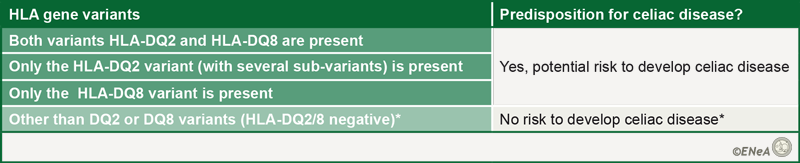
*there are very rare gene variants other than HLA-DQ2/DQ8 which are also associated with risk for celiac disease but these play only an ancillary role
Source: ENeA own
In the following, we will only use the term HLA-DQ2/DQ8 positive or negative when referring to the presence or absence of the risk genes.
How do these variants increase the risk to develop celiac disease?
The HLA-DQ2/DQ8 arm allows the gluten peptide to perfectly fit into their shape, like a key (gluten) into a lock (HLA-DQ2 or HLA-DQ8 molecule) (see figure 6) (Unit 1, lesson 3). If an individual doesn't have either of these HLA-DQ2/DQ8 variants, the gluten fragment will not fit and consequently will not stimulate the immune system.
Therefore only people who carry one or both of the HLA-DQ2/DQ8 variants can develop celiac disease.
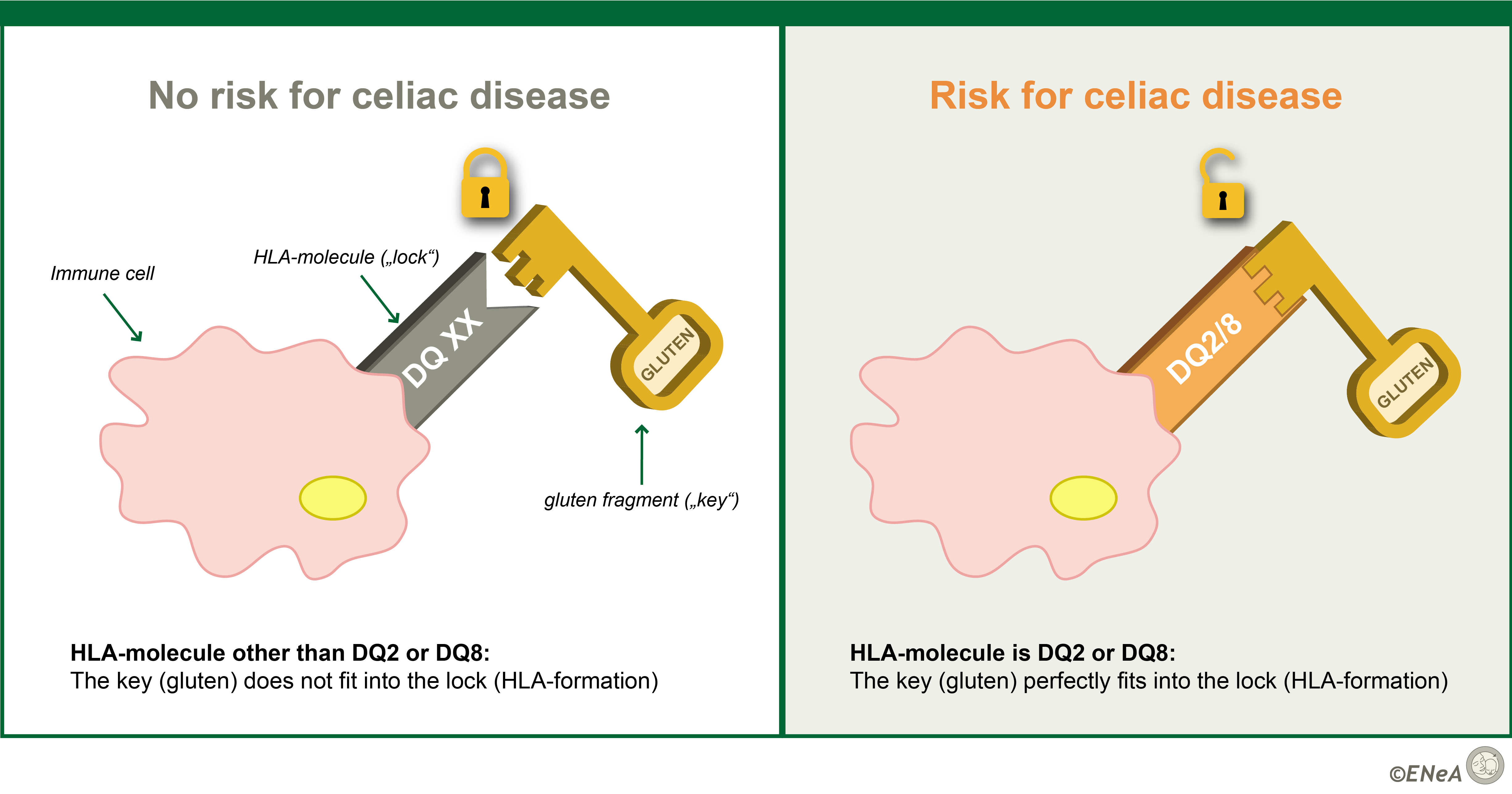 Figure 6: HLA-DQ2/-DQ8 and its role in the development of celiac disease in the gut (simplified illustration)
On the left you can see the situation where the genetic risk is not present (HLA-DQ2 and HLA-DQ8 negative). Gluten does not fit into the lock. In the right picture, you can see what happens if the person is positive for HLA-DQ2/DQ8. Gluten is tightly bound by the HLA-DQ2 (or HLA-DQ8) molecule of the immune cell, which may provoke an immune reaction.
Source:ENeA own