Lesson 3: Atopic Disease: Allergy, Eczema, Asthma
3.3 Age of Introduction of Complementary Food and Atopic Diseases
The European Society for Pediatric Gastroenterology, Hepatology and Nutrition stated in 2008 that the evidence for delaying or avoiding the introduction of allergenic foods (such as fish, eggs, and foods containing peanut protein) prevents or delays the development of allergy is not convincing in infants considered at risk for the development of allergy or in those not considered to be at risk (Agostoni et al. 2008).
In 2009 the EFSA stated that the available data are insufficient to make a conclusion of the appropriate age for introduction of complementary foods for allergy prevention or reducing the risk of allergy (EFSA Panel on Dietetic Products Nutrition and Allergies (NDA) 2009).
The American Academy of Pediatrics agree that
"although solid foods should not be introduced before 4 to 6 months of age, there is no current convincing evidence that delaying their introduction beyond this period has a significant protective effect on the development of atopic disease. This includes delaying the introduction of foods that are considered to be highly allergic such as fish, eggs, and foods containing peanut protein."
(Greer et al. 2008)
Table 1: 14 foods or food additives identified as being the source of the majority of adverse food reactions
(EU Directive list)
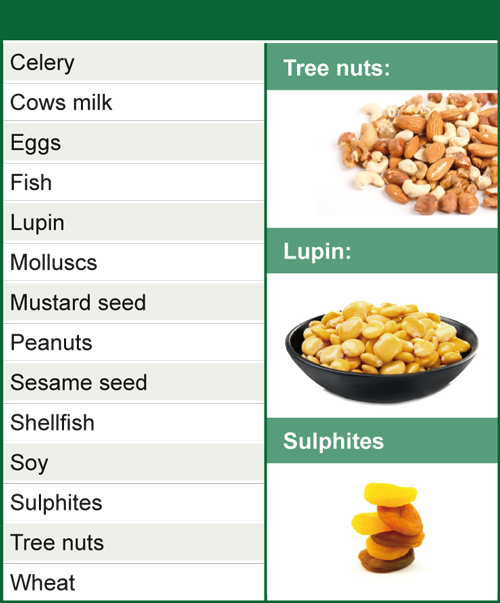
Source: Table ENeA, data from the Commission of the European Communities 2007
A more recent review by Sansotta et al (2012) agreed with these recommendations and concluded that
"there is no convincing scientific evidence that avoidance or delayed introduction of potentially allergenic foods, such as fish and eggs reduces allergies either in infants considered at increased risk for development of allergy or even in those not considered to be at increased risk.”
(Sansotta et al. 2012)
Delayed Introduction
There is some evidence that delaying the introduction of certain foods may actually increase, rather than decrease the prevalence of allergic diseases (Sansotta et al. 2012), even in families at high risk of atopic diseases (deSilva et al. 2014). A number of studies have shown an increased risk of atopic dermatitis, eczema and allergic sensitization with delayed introduction of eggs, milk, cereals and other solids (Sariachvili et al. 2010; Snijders et al. 2008; Zutavern et al. 2004).
Early Introduction
A systematic review in 2006 concluded that there was
"no strong evidence to support the association between early solid feeding and the development of persistent asthma, persistent food allergy, and allergic rhinitis.”
(Tarini et al. 2006)
Recent studies suggest that exposure to complementary foods, including potentially allergenic foods in the 4-6 months age range may reduce the risk of food allergies compared with children first exposed either before or after this "critical window” (Prescott et al. 2008). However more studies are needed to examine the role of the early introduction of complementary foods (Michaelsen et al. 2010).
In summary, current research and recommendations suggest that all complementary foods can be introduced with no restriction from 5-7 months of age on, including allergenic foods. This also applies to families at high risk for allergies.