Lesson 5: Preterm Infant Nutritional Management in Low-resource Settings
5.3 Care Management and Discharge Practice
In many resource-limited settings, hospitals have Kangaroo Mother Care (KMC) units attached to the hospital. In these units, postpartum mothers of preterm infants can become involved in the care of their infants, receive help with human milk expression, and start skin-to-skin contact with their infants, gradually advancing to continuous KMC. (Please see Unit 1, Lesson 3.3 for more information on KMC.) They also benefit from the contact with other mothers in a similar situation (WHO et al. 2012; Murguia-Peniche & Kirsten 2014).
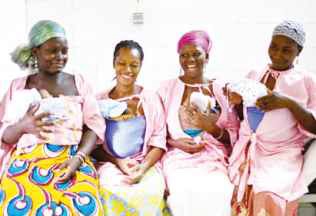
Source: WHO et al. 2012
Breastfeeding is introduced while the infant is still receiving tube feedings. As the infant progresses with feeds at the breast, tube feedings are used to "top-up” intakes, ensuring that the infant receives adequate volumes for growth. Infant weights are followed daily and growth is tracked weekly. Electrolytes are also followed weekly in hospitalized breast milk fed infants, with supplementation added to feeds as necessary. Infants may be discharged home at or after a gestational age of 35 weeks and at a weight of 1650-1800g. Babies are not discharged home with a gastric tube in place. In the home setting, cup feedings are used for topping-up after feeding at the breast. Cups are preferred to bottles in resource-limited settings as they are easily sterilized (Murguia-Peniche & Kirsten 2014).
Following discharge, it is recommended that preterm infants in resource-limited settings receive multivitamin supplements, if available, for the first year of life (Murguia-Peniche & Kirsten 2014). Universal iron supplementation of infants and children in resource-poor areas where malaria is endemic has become a highly controversial issue. In 2006 a large randomized controlled trial was published, reporting on folic acid and iron supplementation in children in Pemba, Zimbabwe, an area where both iron-deficiency anemia and malaria are very common. The study had to be terminated early when it became evident that there were significantly more hospital admissions and deaths in the children receiving supplementation (Sazawal et al. 2006). Though the exact relationship between iron intake and malaria infections has not been fully elucidated, it is generally felt that in malaria-endemic regions providing iron supplements to children who are not iron-deficient may be harmful. The WHO revised its guidelines following the Pemba study (WHO 2007). More research is needed to determine the safest way to provide iron supplementation for infants and children in such regions who have iron-deficiency anemia.
Because they are at particularly high risk of iron deficiency, preterm infants in malaria-endemic regions are recommended under the WHO guidelines to receive iron supplementation from 2 to 5 months of life, but only "in conjunction with the measures to prevent and control malaria”(WHO 2007). After 6 months of life, supplementation should target those with demonstrated deficiency. One approach to minimize risk while maximizing benefit is to screen for iron deficiency and give supplementation only in areas where measures to prevent and control malaria are in place and only during seasons when risk of malaria is lower (during dry months) (Prentice & Cox 2012).
Follow-up after discharge should be done at clinics in their communities. Weight and growth should be meticulously monitored and any growth faltering cases should be referred to a doctor. Neurodevelopment should be also assessed in ELBW and VLBW infants. Any delayed neurodevelopmental milestone should also be referred to a doctor and a close follow-up every 4 to 6 months should be performed until 2 years of age.